
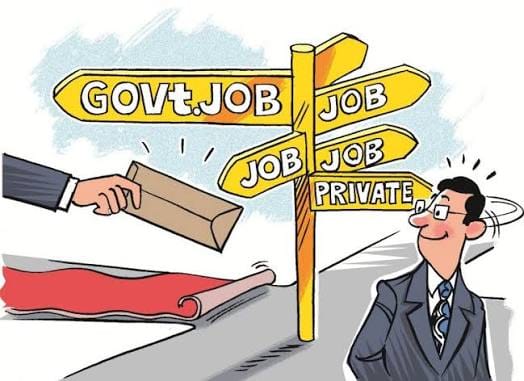
Comparing government jobs with private careers after Class 12 is a crucial decision for students in India. Both pathways offer distinct advantages, depending on your financial priorities, risk tolerance, and long-term career aspirations.
1. Direct Financial & Salary Breakdown
Entry-level government roles accessible after Class 12 include positions such as Lower Division Clerk (LDC), Postal Assistant, and Data Entry Operator (DEO) through SSC CHSL, along with Railway Clerk roles through RRB NTPC.
Government pay structures follow the 7th Central Pay Commission (CPC) Pay Matrix. In contrast, private-sector compensation after Class 12 primarily depends on practical skills, location, and individual company policies.
2. Career Progression & Promotion Timelines
Career growth paths differ fundamentally between government institutions and private enterprises. While government employees generally follow structured promotion systems, private-sector employees can advance more quickly by developing skills and changing jobs.
[ Government Path ] ──► Departmental Exams (LDCE) ──► Fixed Grade Pay Promotion
[ Private Sector ] ──► Skill Acquisition ──► Performance Appraisals / Job Hops
Government Sector Growth
Structured Advancement: Government departments promote employees through seniority lists and Limited Departmental Competitive Examinations (LDCE).
Predictable Increments: Additionally, employees receive an annual 3% basic pay increment, along with bi-annual Dearness Allowance (DA) revisions.
Private Sector Growth
Skill-Driven Escalation: In the private sector, individuals who master high-demand technical skills, such as Digital Marketing, Data Analytics, and Software Development, can increase their income rapidly through corporate job switches.
Uncapped Earning Potential: Although private-sector jobs initially offer lower pay after Class 12, acquiring specialized credentials or an online degree can help employees unlock significant salary increases within 3 to 5 years.
3. Key Selection Criteria: Which Path Should You Choose?
Choose a Government Career If:

You Value Long-Term Stability: Choose a government career if you want a secure job with predictable working hours and government-backed healthcare benefits.
You Are Prepared for Competitive Exams: A government career suits you if you are willing to dedicate 6–12 months to mastering Quantitative Aptitude, Reasoning, General English, and General Awareness for exams such as SSC CHSL, RRB NTPC, or State PSCs.
You Want Equal Starting Wages: Government pay matrices guarantee standardized salaries regardless of gender or personal negotiation skills.
Choose a Private Career If:
You Need Immediate Cash Flow: A private career may suit you if you cannot dedicate several months to preparing full-time for competitive recruitment exams with uncertain selection ratios.
You Prefer Fast-Paced Environments: Choose the private sector if you thrive in fast-paced environments, value merit-based growth, and want to focus on technical skill development.
You Plan to Pursue Higher Education Simultaneously: The private sector can also suit you if you intend to earn through a private job while pursuing a distance or online Bachelor’s degree, such as B.Com, BCA, or BBA.
Popular Government Exams After Class 12
Students looking for government employment immediately after high school can apply for several prominent national competitive exams. Therefore, students can explore the following options:
SSC CHSL (Combined Higher Secondary Level): The Staff Selection Commission conducts this examination annually for roles such as Lower Division Clerk (LDC), Junior Secretariat Assistant (JSA), and Data Entry Operator (DEO).
SSC Stenographer (Grade C & D): Candidates who possess shorthand typing skills can take this examination for secretarial posts across central ministries.
RRB NTPC (Undergraduate Posts): Railway Recruitment Boards conduct this examination for posts such as Commercial cum Ticket Clerk, Accounts Clerk cum Typist, and Junior Time Keeper.
State Police & Defense Posts: Additionally, candidates can apply through recruitment drives for Constable posts in State Police forces, Indian Army Soldier General Duty, and Indian Navy SSR/AA entry schemes.
ALSO RECOMMENDED — Active Recall vs. Passive Reading: 3 Proven SSC Strategies
Written by: Suresh Kumar
Reviewed by: Nokari Editorial Team
Published: 5 October 2026
Last Updated: 5 October 2026
About the Author


2 thoughts on “Govt Jobs vs Private: Proven Secrets for Class 12”
Comments are closed.