
Pietro Bracci Lost Sculpture Salvage Yard
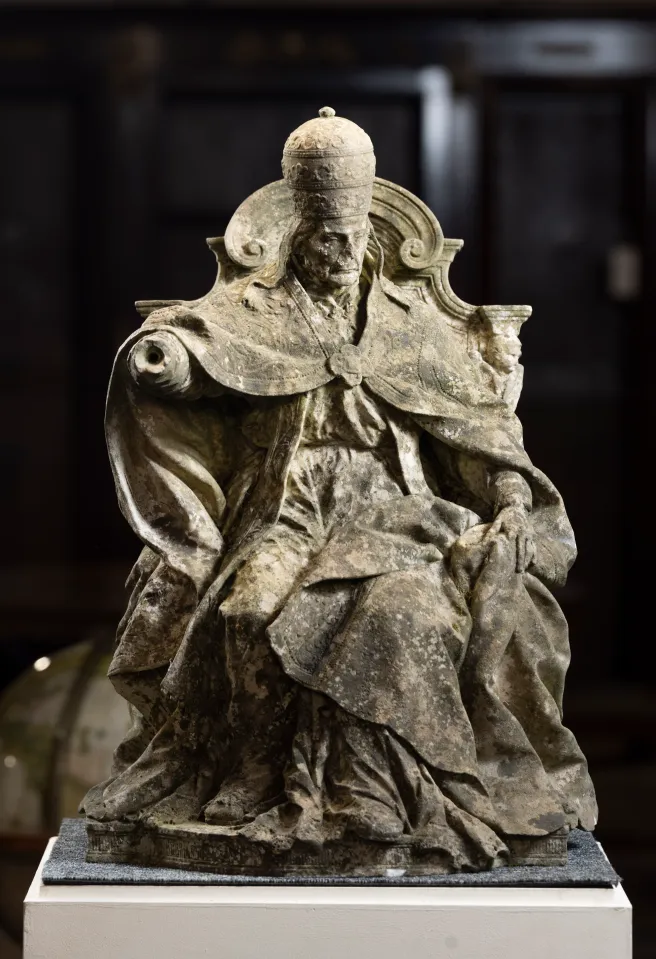
Imagine walking through a dusty salvage yard in England when, suddenly, you spot a 27-inch sculpture tucked between garden odds and ends.
At first glance, the weathered piece looked like nothing more than a cheap concrete garden ornament. It was stained, covered in green lichen, and had clearly endured years of neglect. Nevertheless, one eagle-eyed collector noticed something unusual. The yard owners had priced the sculpture at just £300 (around $400), so the collector bought it on the spot.
Soon afterward, the collector took the mysterious piece to the art experts at Woolley & Wallis in Salisbury. However, the experts quickly discovered that the sculpture was far more valuable than anyone had imagined.
In fact, it wasn’t cheap concrete at all. Instead, they identified it as an authentic, hand-carved marble maquette of Pope Clement XII Corsini, created in 1736 by Pietro Bracci—the renowned Italian sculptor who later created the central figures of Rome’s iconic Trevi Fountain (La Dolce Vita!).
As a result, what had looked like a forgotten garden ornament turned out to be a remarkable piece of Italian art history.
[ 1736: Pietro Bracci Carves Marble Maquette ]│
▼
[ Full-Size Bronze Cast for Palazzo Nuovo ]
│
▼
[ 1798: Monumental Bronze Melted Down/Destroyed ]
│
▼
[ Decades: Statue Sits Unrecognized in Hampshire Garden ]
│
▼
[ Salvage Yard Discovery in Wiltshire (£300) ]
│
▼
[ Oct 8 Auction at Woolley & Wallis (£5k–£10k Est.) ]
Why This Discovery Matters
This find goes far beyond a lucky bargain. It restores a critical piece of lost Roman history that scholars thought was gone forever.
1. The Lost Papal Monument
Back in 1736, Bracci carved this miniature marble model as a prototype for a monumental bronze statue. Craftsmen used his prototype to cast a full-scale portrait of Pope Clement XII, which stood proudly in the Great Hall of the Palazzo Nuovo in Rome.
2. Destroyed in the Fires of Revolution
That massive bronze statue didn’t last long. In 1798, French-backed forces occupied Rome during the First Republic, tore down the monument, and melted the metal down into coins and ammunition.
3. The Only Surviving 3D Record
For 228 years, art historians relied entirely on a single two-dimensional engraving to guess what Bracci’s bronze statue actually looked like. By finding this original marble maquette, we can finally examine Bracci’s original artistic vision in full 3D detail.
How Did a Roman Masterpiece End Up in an English Garden?
Tracing the statue’s journey reveals an incredible backstory.
Auction specialist Mark Yuan-Richards tracked the piece back to a manor house in Andover, Hampshire, where it sat outside in the garden for decades. Years of British rain, frost, and moss eroded the marble’s polished coat, making it rough and dull—perfectly mimicking cast concrete to anyone passing by.
[ 18th Century: Papal Court / Grand Tour Export ]│
▼
[ 19th–20th Century: Private Hampshire Manor Estate ]
│
▼
[ 21st Century: Local Salvage Yard in Wiltshire ]
Crossing the Continent
How did it cross from Rome to Hampshire? During the 18th century, wealthy British aristocrats traveled through Europe on the “Grand Tour,” collecting fine Italian sculptures to decorate their country homes. Alternatively, the Pope may have presented it as a diplomatic gift to a British dignitary.
Quick Facts & Auction Breakdown
Collectors, museum curators, and historians around the world are watching this sale closely because original works by Bracci almost never hit the open market.
| Feature | Details |
| Sculptor | Pietro Bracci (1700–1773) |
| Subject | Pope Clement XII Corsini |
| Creation Date | 1736 |
| Material | Hand-Carved White Marble |
| Height | 68 cm (27 inches) |
| Origin | Wiltshire Salvage Yard (via Andover Manor) |
| Purchase Price | ~£300 ($400) |
| Auction Estimate | £5,000 – £10,000 ($6,600 – $13,000+) |
| Auction House | Woolley & Wallis (Salisbury, UK) |
| Sale Date | October 8 |
What Happens Next at Auction?
The sculpture officially hits the auction block on October 8 as part of the Fine Furniture and Collections sale at Woolley & Wallis.
While the catalog lists an estimate between £5,000 and £10,000, experts believe competitive bidding could push the price much higher. Similar Italian preliminary models have fetched up to £170,000 at past auctions. Given its direct connection to the Trevi Fountain’s sculptor and its place in art history, don’t be surprised if major international museums fight for this piece.
Written by: Suresh Kumar
Reviewed by: Nokari Editorial Team
Published: 3 October 2026
Last Updated: 2 October 2026
About the Author